But what's async anyway? (stackless coroutines)
But what’s async anyway?
Intro
Imagine a simple program whose job is to periodically send requests to server1 and server2. The delay before the next request is determined by the previous response; if you stop sending, your computer will blow up. How could it be implemented? Naively, like this:
def send_to_server(addr):
    time_before_next_request = 0
    while True:
        time.sleep(time_before_next_request)
        resp = http.request("GET", addr)
        time_before_next_request = int(resp.data)

def main(addr1, addr2):
    send_to_server(addr1)
    send_to_server(addr2)
Why this approach fails
Looks fine and your computer is safe, isn’t it?
Not at all, because first send_to_server will
single-handedly occupy the whole thread of execution forever and you’ll
never reach the second call! It’s definitely
not something great, and we must find a new solution. You could
think about using several threads of execution
(and it’ll definitely work), but I can show you a way of reaching the
same goal within a single thread.
A naive async solution
If you know some Python, you might immediately come up with such a beautiful solution:
async def send_to_server(addr):
    time_before_next_request = 0
    while True:
        await asyncio.sleep(time_before_next_request)
        resp = http.request("GET", addr)
        time_before_next_request = int(resp.data)

async def main(addr1, addr2):
    join = asyncio.gather(
        send_to_server(addr1),
        send_to_server(addr2)
    )
    await join

asyncio.run(main())
Remark: Notice that this code is still not truly asynchronous, because http.request blocks the thread. We’ll fix that in a moment. For now, let’s stick to this implementation.
If you are looking at this masterpiece of a syntax construction and already regret that you’ve opened this post, stop. It will become clearer in a moment. And even if you’ve come up with something like that, you might not fully understand what it means and how it is implemented, so let’s talk about it!
Building intuition
The goal of async
So, let’s first think about what we want from our code. The obvious goal is
“One function should be able to work while another is sleeping.”
But our functions have variables with the same exact name! Won’t this
variable be overwritten? Or even the argument addr! To avoid this
kind of stuff, we can save the state of a function each time
we think that other functions have time to be executed (we
mark these places with the await keyword):
{
    function_name: "send_to_server",
    next_line: 4,
    variables: {
        addr: <some_server_addr>,
        time_before_next_request: <some_value>,
    },
}
Introducing the runtime
Okay, our function’s states are safe, but how will we know when
some function should be called? We have a finite amount of tasks
that should be continued at some point, and each of those has the same
priority (if you miss a request to any of the servers, your computer
won’t live long), so that sounds like a loop! Also, we have some
“system state,” not only state for each function, so let’s call
this state runtime:
class Runtime:
    tasks_ready_to_continue: List[(int, func_state)] # some id + state
    timers: List[(time.time, (int, func_state))] # when should end + which task in

    ... # <some functions, that we will use later and which are trivial>
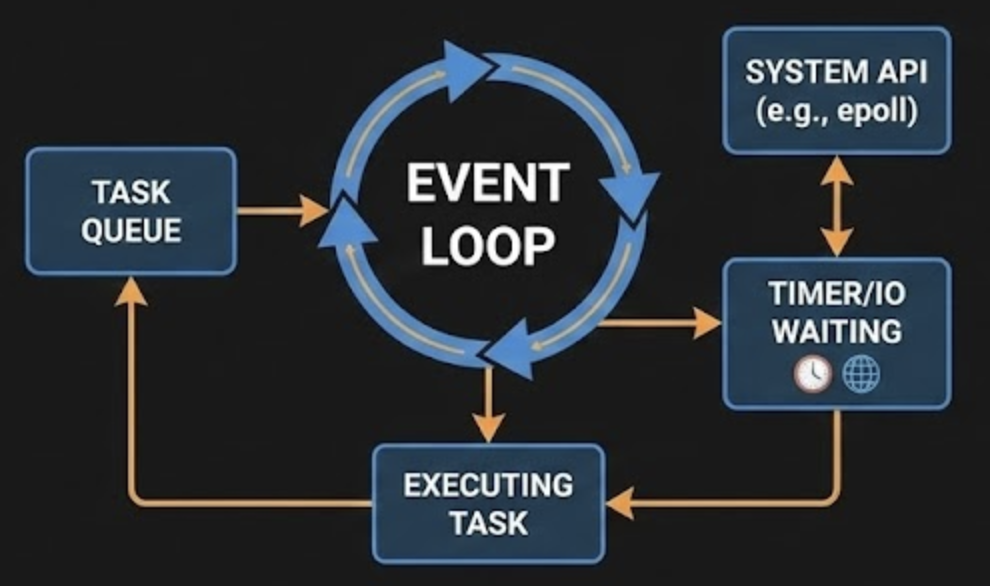
Designing the event loop
And now, as we have Runtime, let’s try to design our own loop!
Remark: basically, when we use
await, the function saves its state and “jumps” to the loop
while True:
    # this loop is often called **event loop**!

    # continue all tasks that we can right now!
    # (but only one at a time, because single thread)
    while runtime.tasks_ready_to_continue:
        task = runtime.tasks_ready_to_continue.pop()
        runtime.continue_executing(task)


    # but what if there are no tasks?
    closest_timer = min(runtime.timers)
    time_left  = closest_timer[0] - time.now()

    time.sleep(max(0, time_left)) # thread can sleep without hesitation

    timers = []
    while runtime.timers:
        timer = runtime.timers.pop()
        if time.now() >= timer[0]:
            runtime.tasks_ready_to_continue.append(timer[1])
            continue
        timers.append(timer)
    runtime.timers = timers
The problem with blocking calls
This solves the ‘sleep’ part, but we still have a problem:
the HTTP request itself is blocking. While http.request is
running, the whole thread is stuck and no other coroutine can
make progress.
So, we should add await to the HTTP request like this, right?
async def send_to_server(addr):
    time_before_next_request = 0
    while True:
        await asyncio.sleep(time_before_next_request)
        resp = await aiohttp.request("GET", addr)
        time_before_next_request = int(resp.data)
Supporting non-timer events
But our loop (for now!) has no way to work with non-timer events.
In Linux, there exists an API called epoll
(MacOS has kqueue and Windows has IOCP, which do
practically the same). You can think about it as a structure
that can store some amount of
files (a socket that we use in an HTTP request is a file too!) and
answer a question: “Which of these files are ready to be read from
or written to?”. The function answering that question is
called epoll_wait. You don’t need to understand how epoll is
implemented, just remember what its function is.
Finalizing the event loop
Now, with that in mind, let’s add support for non-timer operations!
while True:
    while runtime.tasks_ready_to_continue:
        task = runtime.tasks_ready_to_continue.pop()
        runtime.continue_executing(task)

    closest_timer = min(runtime.timers)
    time_left     = closest_timer[0] - time.now()

    # when we can read from a file, epoll returns some "event" that
    # includes a previously specified value. let's assume that we've
    # specified (task_id, state) for each non-timer operation
    events = []

    # also, let's assume that epoll already has necessary files
    # epoll wait returns the number of files that can be interacted with
    n = epoll_wait(epoll=runtime.epoll,
                   events_list=events,
                   timeout=max(0, time_left))

    if n == 0:
        # timer was earlier than any file was ready
        timers = []
        while runtime.timers:
            timer = runtime.timers.pop()
            if time.now() >= timer[0]:
                runtime.tasks_ready_to_continue.append(timer[1])
                continue
            timers.append(timer)
        runtime.timers = timers
        continue # as no files need any interaction with

    for ev in events:
        runtime.tasks_ready_to_continue.insert(0, ev.data)
        epoll_remove(ev) # as we already got what we wanted
When async is useful
And that’s the final version of our event loop! It handles multiple
tasks at once, can work with timers, and keeps your computer safe in
case of a very specific and unrealistic problem that almost certainly
won’t ever happen in your life! But there are some cases when async is really needed:
- Web servers that get many requests at once. Threads are good, but threads that can handle multiple requests at any time are cooler!
- Database access in your app (they’re relatively slow too)
- Background processing of external programs
- Many other things
Function coloring problem
If you’ve read carefully, you might have noticed a problem: await
can be used only in an async function, because any other function
doesn’t have a state that is saved somewhere. That means you can’t
await an async function from a normal function. Once some function
needs await, it usually has to become async too, and this can
propagate through your codebase. This phenomenon is called
function colouring, which exists across
multiple languages and is a design choice, not a bug. Wonder how
you can deal with it? Accept.
Conclusion
Obviously, our implementation of the event loop is not ideal. It lacks
proper error handling, is not very optimal, and doesn’t include the implementation
of a real-world state machine for functions, etc., but I hope the process
of building it gave you some intuition about how async in Python, Rust,
JavaScript, and C# is implemented (this model is called stackless
coroutines). async makes the compiler store functions’ state somewhere, and await saves it for the caller and jumps to
the event loop where it waits for the next event.
And also, that’s not the only way of implementing concurrent execution, but that’s a theme for another post :)
Thanks for reading!
Read more about it
by miko089